
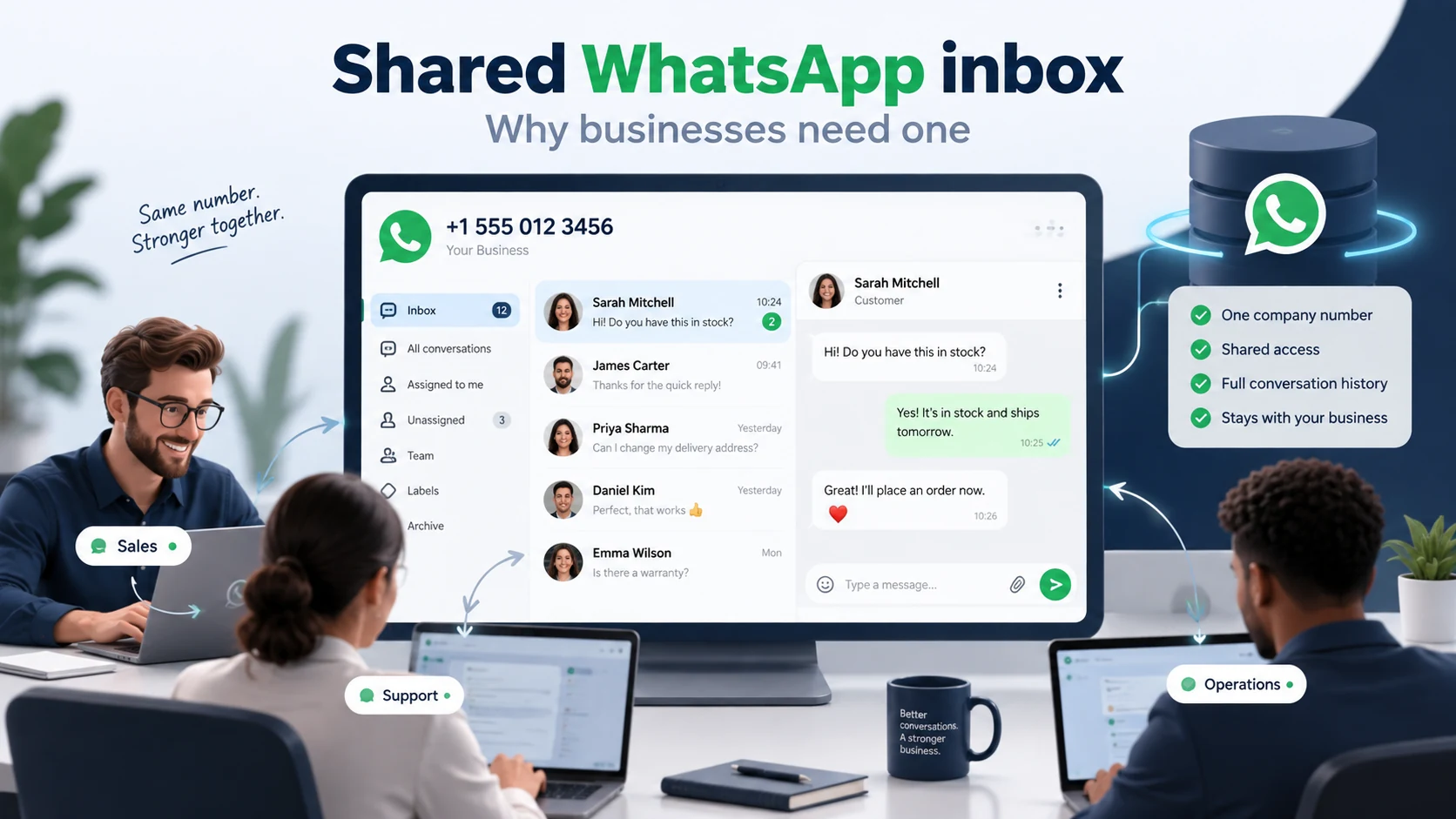
WhatsApp has become a major business channel. Customers ask for prices, send product photos, place repeat orders, follow up on deliveries and discuss service issues there.
The problem is that many businesses still manage WhatsApp through individual employee numbers. That may work when the team is small, but as the company grows, it creates customer ownership, continuity and visibility problems.
In this article
We will look at:
- How businesses usually manage WhatsApp today
- Why employee-owned conversations are risky
- Why multiple company numbers confuse customers
- How customer history gets scattered
- What a shared WhatsApp inbox changes
- How assignment and ownership can still remain personal
- What the business and customer ultimately gain
1. How businesses usually manage WhatsApp today
The common setup is simple: every salesperson or department has its own WhatsApp number.
A customer might speak with:
- one salesperson for quotations
- another person for dispatch
- accounts for payments
- support for complaints
- a different salesperson when the original contact is unavailable
Internally, this may feel organised because every employee has a defined responsibility.
But externally, the customer relationship becomes spread across multiple numbers, devices and people.
Over time, the company may have hundreds of customer conversations that technically belong to the business but practically live inside individual employees’ phones.
2. The biggest risk: employees can carry customers with them
A salesperson may spend several years communicating with customers from the same WhatsApp number. During that time, they build relationships, understand buying patterns and become the customer’s default point of contact.
If that employee leaves, the company may lose more than just a team member.
The employee may still carry:
- customer phone numbers
- years of conversation history
- knowledge of regular products
- pricing discussions
- buying frequency
- key decision-makers
- upcoming requirements
The risk becomes even greater if the employee joins a competitor.
The customer may not actively decide to change suppliers. They may simply continue talking to the same salesperson they have known for years.
The employee now has new sales targets, a new company and an existing network of familiar customers. Slowly, enquiries can move, followed by quotations and eventually orders.
In practical terms, the salesperson has carried part of the customer relationship from one company to another through their phone.

3. Internally you have departments. The customer sees one company.
Companies naturally divide themselves into sales, accounts, dispatch, support, service and other departments.
Customers do not think that way.
To them, you are one company.
They should not need to remember:
- which number is for quotations
- which number belongs to dispatch
- who handles accounts
- which salesperson now manages their business
- who replaced the person they previously contacted
A customer who has worked with your company for years should not need to maintain a directory of your internal departments.
The ideal experience is much simpler:
One company. One WhatsApp number. One place to communicate.
Your internal complexity should remain internal.

4. Scattered numbers also scatter customer history
The issue is not only who owns the phone number. Valuable business information also becomes fragmented across different conversations.
One salesperson may know the products a customer regularly buys. Another may know about a special price. Someone else may have handled a complaint or discussed an upcoming requirement.
When this information sits across individual WhatsApp accounts, nobody has a complete picture.
This can lead to:
- customers repeating information they already provided
- new salespeople starting without previous context
- unanswered enquiries being difficult to identify
- important product requirements getting lost
- previous quotation discussions disappearing with employees
- management having limited visibility into customer communication
The company may technically possess the information, but it does not possess it as usable company knowledge.
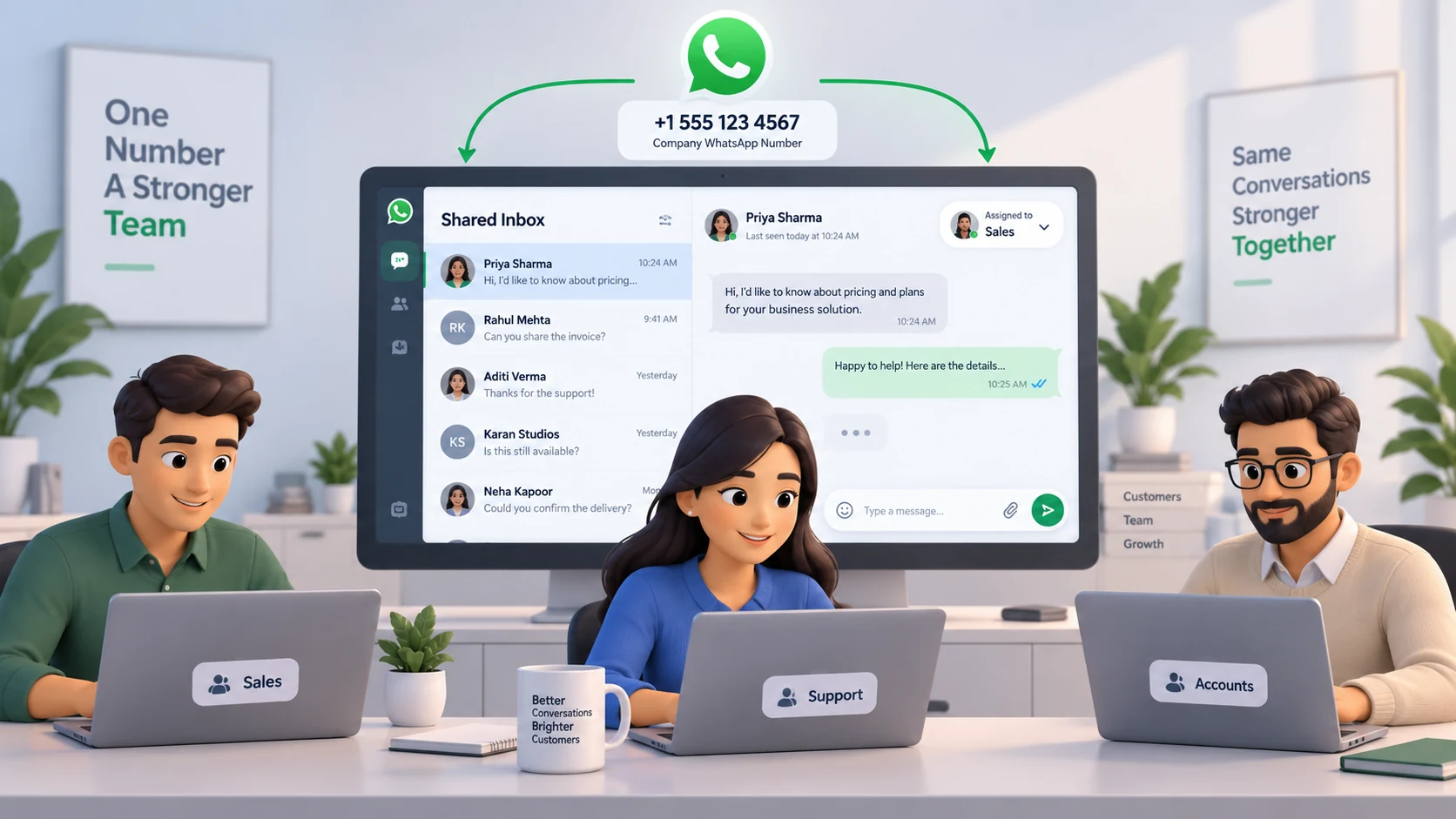
5. A better model: one company WhatsApp number
A shared WhatsApp inbox changes this without making communication less personal.
Customers message one company number.
Behind that number, the business decides who should handle the conversation.
The customer still talks to a real salesperson. They can still build a relationship with that salesperson.
The important difference is that the communication channel and conversation history remain with the company.
Employees can change without forcing customers to change how they contact you.
6. How a shared inbox can work internally
Having one WhatsApp number does not mean every salesperson randomly answers every conversation.
The company can still organise ownership properly.
Round-robin assignment
New enquiries can be distributed automatically between available salespeople, keeping workload balanced and ensuring every new customer has an owner.
Dedicated salesperson ownership
Once assigned, the same salesperson can continue handling the customer. The relationship remains personal even though the company owns the communication channel.
Easy reassignment
If an employee goes on leave, changes roles or leaves the company, the customer can simply be reassigned internally.
The customer keeps messaging the same number.
Shared conversation history
The next salesperson can see what has already been discussed instead of asking the customer to start again.
Internal departmental handover
Sales, service or another department can handle the conversation internally without asking the customer to save another phone number.
The customer sees one company. The business handles everything behind the scenes.
7. What the business and customer ultimately gain
What the customer gains
For the customer, the biggest benefit is simplicity.
They get:
- one reliable WhatsApp number
- no need to save department-wise contacts
- continuity even when employees change
- less repetition of previously shared information
- a smoother handover between people or teams
- one clear place to return for future enquiries
They simply message the company and let the business manage what happens internally.
What the business gains
For the business, the benefits are broader:
- continuity when employees leave
- better visibility into customer conversations
- easier reassignment of enquiries
- less dependency on individual employees
- preserved customer history
- clearer ownership of unanswered enquiries
- one official communication channel
- better protection of customer relationships
Most importantly, customer communication remains an asset of the company rather than something trapped inside individual phones.
The long-term value: sales history
Over time, those conversations become valuable sales history.
A customer may return months later asking for a similar product, a repeat quotation or a variation of something discussed before.
Being able to see what they asked for, what was quoted, which products were suggested and how the requirement changed gives the salesperson valuable context for the next opportunity.
That history can make future sales faster, more relevant and easier to manage.
STIMA builds on this model by allowing a company WhatsApp number to be shared across the sales team while keeping customer conversations, RFQs and quotation activity connected.
The salesperson can still have a personal relationship with the customer, but the conversation and quotation history stay with the business — ready for the same salesperson, their replacement or anyone handling the next opportunity.
That turns WhatsApp from an employee-owned communication channel into a business-owned source of customer and quotation knowledge.