

Order history tells you what customers bought.
Quotation history tells you what they wanted to buy, nearly bought, or could not buy from you.
That difference makes quotation data useful far beyond simply checking an old price.
1. Lost quotations show where revenue is leaking
A lost quotation is still a real opportunity that reached your business.
Looking at quotation history can show where the biggest gaps are:
- product categories with poor conversion
- customers who ask frequently but rarely order
- unusually low conversion in certain regions or accounts
- large quoted values that never become revenue
Not every lost quote could have been won. But if the same pattern appears again and again, it deserves attention.
2. Customers may be asking you to expand your catalogue
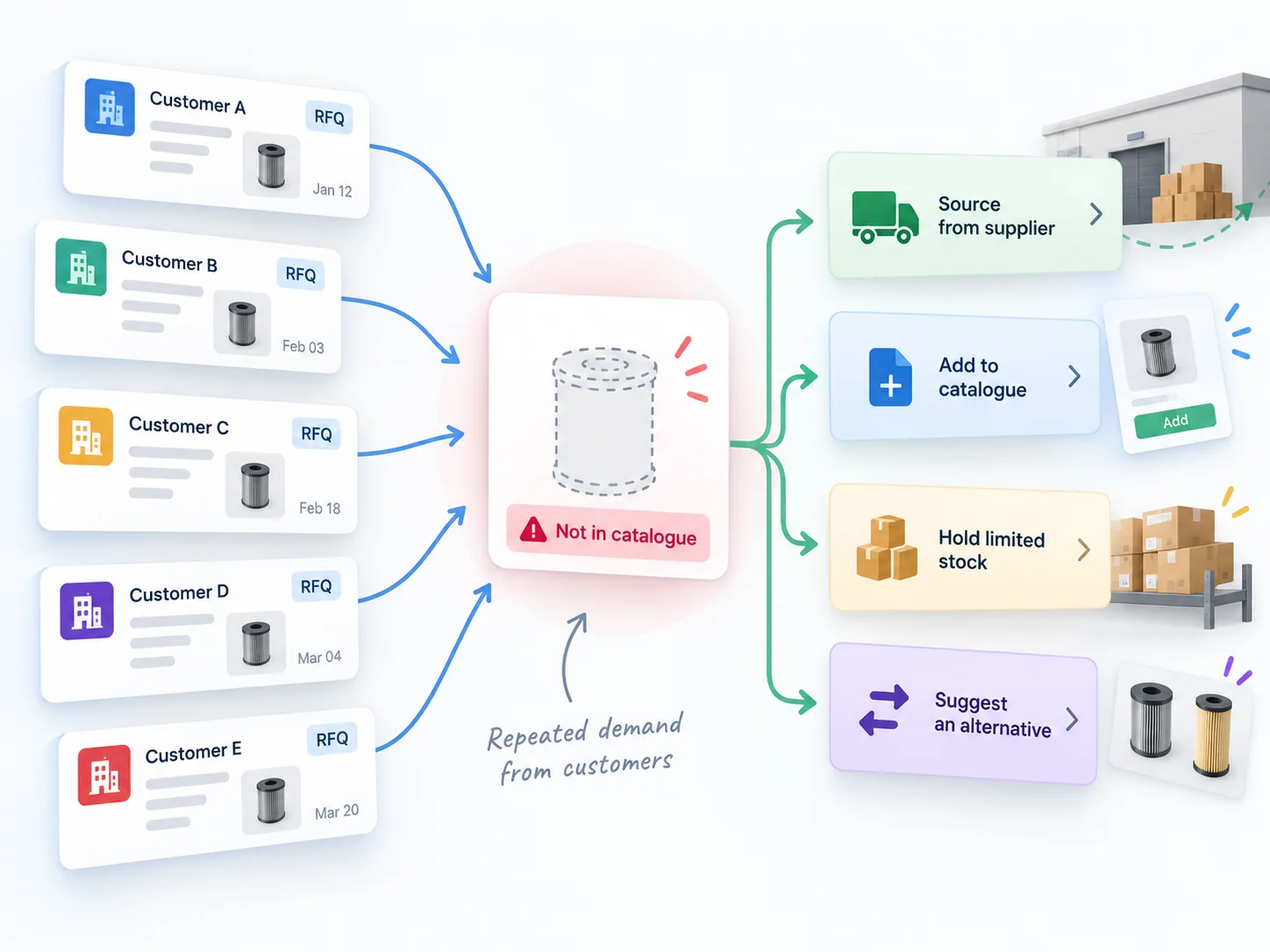
Suppose one customer asks for a product you do not sell.
That may mean nothing.
Now suppose six different customers ask for the same thing over the next few months.
Your order history will still show zero demand, because you never sold it.
Your RFQ history tells a different story.
If that product fits your market, repeated requests may justify sourcing it, adding it to the catalogue, keeping limited stock or finding a reliable alternative.
Sometimes customers tell you what to sell next before your sales reports ever can.
3. Quotation activity can reveal demand before orders do
Orders are delayed signals. A customer may research, compare and request pricing weeks or months before purchasing.
Quotation activity can therefore show changes earlier.
You might notice more requests for a particular specification, larger quantities appearing, or a product family suddenly showing up across several customers.
That does not automatically mean you should change your inventory.
But it is useful information for purchasing, stock planning and deciding where the sales team should pay attention.
4. The changes customers request are often more useful than the final order
A final order tells you what the customer accepted.
It does not always tell you what they rejected first.
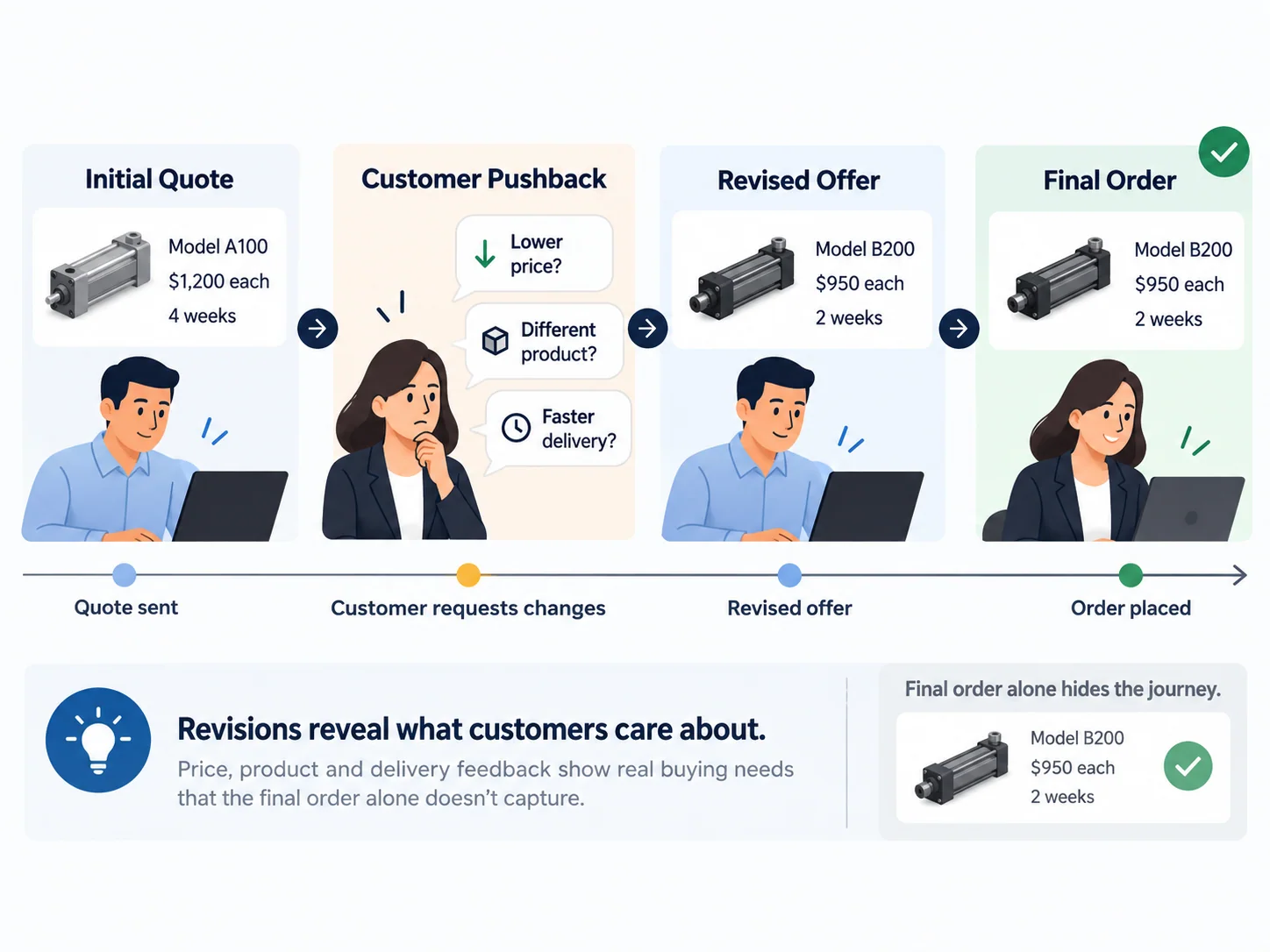
Consider a quote that gets revised three times:
Original product → cheaper alternative → shorter lead time → order
The order history records the final item.
The quotation history shows that price and delivery time shaped the decision.
Across hundreds of quotations, those revisions can expose common friction around pricing, availability, specifications or product choice.
5. Old quotations make future conversations easier
Quotation history is especially useful with repeat customers.
A salesperson can quickly see:
- what the customer considered previously
- which alternatives were discussed
- what quantities they normally request
- what was quoted before
- requirements that appear repeatedly
That context matters even when the previous quotation never became an order.
The next enquiry does not need to begin from zero.
There is demand hidden between the RFQ and the order
Most businesses analyse orders because that is where the revenue sits.
But a lot happens before the order.
Customers ask for products you do not sell. They reject certain options. They request alternatives. They negotiate. Some opportunities disappear completely.
Order history captures the outcome.
Quotation history captures much of the intent behind it.
Used properly, that can help a business improve its product range, understand lost opportunities and spot demand that would otherwise never appear in a sales report.
STIMA keeps RFQs, product matches, quotations and customer history connected instead of leaving that information buried across PDFs, emails and individual conversations.
Over time, the quotation archive becomes more than a record of old prices. It becomes a useful picture of what customers have been asking the business to sell.